

Our company is involved in preparing official permits from the Polish Ministry of Development and Technology, which allows us to export all dual-use drones, optics, and portable radiophones without VAT on the Polish side / and without VAT on the Ukrainian side.
Hotech HyperStar Laser Collimator 14" (64686)
Achieving precise star collimation normally requires ideal conditions: clear skies, no wind, stable temperatures, minimal light pollution, a well-aligned tracking mount, thermal equilibrium of the optical tube, and a suitably bright reference star. In reality, these factors are rarely all present at the same time. As a result, traditional star collimation often becomes a frustrating trial-and-error process, moving back and forth between the front and rear of the telescope, adjusting screws while trying to judge concentricity through a high-magnification eyepiece as the defocused star image constantly shifts.
3054.61 lei net price (non-EU countries)
Anatolii Livashevskyi
Product Manager
/ ![]()
+48721808900
+48721808900
+48721808900
[email protected]
Description
Accurate Collimation Without Using a Star
Achieving precise star collimation normally requires ideal conditions: clear skies, no wind, stable temperatures, minimal light pollution, a well-aligned tracking mount, thermal equilibrium of the optical tube, and a suitably bright reference star. In reality, these factors are rarely all present at the same time. As a result, traditional star collimation often becomes a frustrating trial-and-error process, moving back and forth between the front and rear of the telescope, adjusting screws while trying to judge concentricity through a high-magnification eyepiece as the defocused star image constantly shifts.
Artificial stars are also an imperfect solution. They cannot truly replicate a real star because collimation is performed at a finite distance rather than at infinity. After collimating with an artificial star, refocusing to infinity requires moving the primary mirror, which can introduce accumulated mechanical tolerances. In mass-produced Schmidt-Cassegrain telescopes, effects such as sticky baffles and mirror flop may further alter alignment, making the previous collimation ineffective. Ideally, collimation should be performed at the same focus position used for actual observing or imaging, without major optical displacement. The HyperStar Laser Collimator enables exactly this, avoiding the common sources of error.
Collimation Within the Telescope’s Focal Distance
The HyperStar Laser Collimator achieves high-precision collimation without requiring long distances. By using a flat mirror installed at the focal point, where the imaging sensor normally sits, the laser beam passes twice through the optical system. This double-pass method magnifies alignment errors, allowing extremely precise correction. At the same time, the required collimation distance is reduced, enabling a near-field alignment process.
During setup, the collimator is positioned directly in front of the telescope within its focal length. The user stands between the telescope and the collimator, aiming both toward each other. By adjusting the HyperStar collimation knobs, the returning laser beams are brought onto the same path. This makes collimation a convenient and efficient one-person operation.
What HyperStar Is and How It Works
HyperStar is a multi-element optical correction system that replaces the standard secondary mirror in a Schmidt-Cassegrain telescope. Instead of the secondary mirror correcting coma and field curvature, these corrections are handled by the HyperStar optics, which are designed using advanced optical design software. A CCD or DSLR camera is then mounted directly at the front of the telescope.
As a result, a standard Celestron Schmidt-Cassegrain telescope is transformed into a digital Schmidt camera operating at very fast focal ratios: f/2 for C8 and C11 telescopes, and f/1.9 for the C14. This dramatically increases imaging efficiency and takes full advantage of modern digital and CCD camera performance.
Wide-field sky observation, comet imaging, surveys, and deep-sky astrophotography become far more efficient. A 30-second exposure at f/2 delivers similar image brightness to roughly 12 minutes at f/10, reducing exposure times by around a factor of 25. Short exposures greatly reduce the effects of atmospheric turbulence and tracking errors, resulting in sharper images overall.
Because exposure times are so short, field rotation becomes negligible. This means that even alt-azimuth mounts can be used effectively, eliminating the need for an equatorial mount or precise polar alignment. Multiple short exposures can be stacked using image processing software to produce high-quality deep-sky images with minimal effort.
Compatibility and Assembly
HyperStar optical kits are available for C8, C9.25, C11, and C14 optical tube assemblies.
Mechanical conversion kits are offered to make standard Schmidt-Cassegrain telescopes HyperStar compatible. For FastStar-equipped Celestron telescopes, conversion is straightforward: the secondary mirror is unscrewed and the HyperStar system is installed directly using an adapter ring.
Advantages of HyperStar at a Glance
-
Converts a standard Celestron Schmidt-Cassegrain telescope into a digital Schmidt camera while retaining the ability to use it in its original configuration
-
Eliminates problems associated with primary mirror shift
-
Drastically reduces exposure times
-
Simplifies tracking requirements, enabling high-quality astrophotography even with basic alt-azimuth mounts
-
Removes the need for precise polar alignment during mobile operation
-
Enables narrowband astrophotography thanks to the large light-gathering power and wide field
-
Ideal for DSLR cameras, which are optimized for fast focal ratios
-
Fully compatible with the latest generation of Celestron HD Schmidt-Cassegrain telescopes
Frequently Asked Questions About HyperStar
How is focus achieved when using HyperStar for photography?
Focusing is done using the primary mirror, just as in the unmodified telescope configuration.
Can visual observing be done through the FastStar system?
No. Visual observing is not practical because the observer would be positioned in front of the Schmidt corrector, causing excessive obstruction.
Is mirror shift a problem when focusing?
Removing the secondary mirror eliminates the fivefold magnification of an f/10 Schmidt-Cassegrain system. As a result, mirror shift is reduced by a factor of five and is no longer a significant issue.
How good is the image quality?
Image quality is comparable to that of RC astrograph systems. Resolution is suitable for semi-professional cameras, and stars appear much finer than at f/10.
Is camera obstruction an issue?
For photographic use, obstruction is far less critical than for visual observing. Most professional telescopes have even larger central obstructions.
Is re-collimation required when switching back to the standard configuration?
No. The HyperStar lens is collimated during initial use. Reinstalling the original secondary mirror does not require additional collimation.
Are there any disadvantages to using HyperStar?
Yes—clear, moonless nights may suddenly feel too short.
The HyperStar system is one of the fastest and easiest ways to begin deep-sky astrophotography. No equatorial mount, polar alignment, or guiding is required. Deep-sky images can be captured in seconds rather than hours, making astrophotography more accessible than ever.
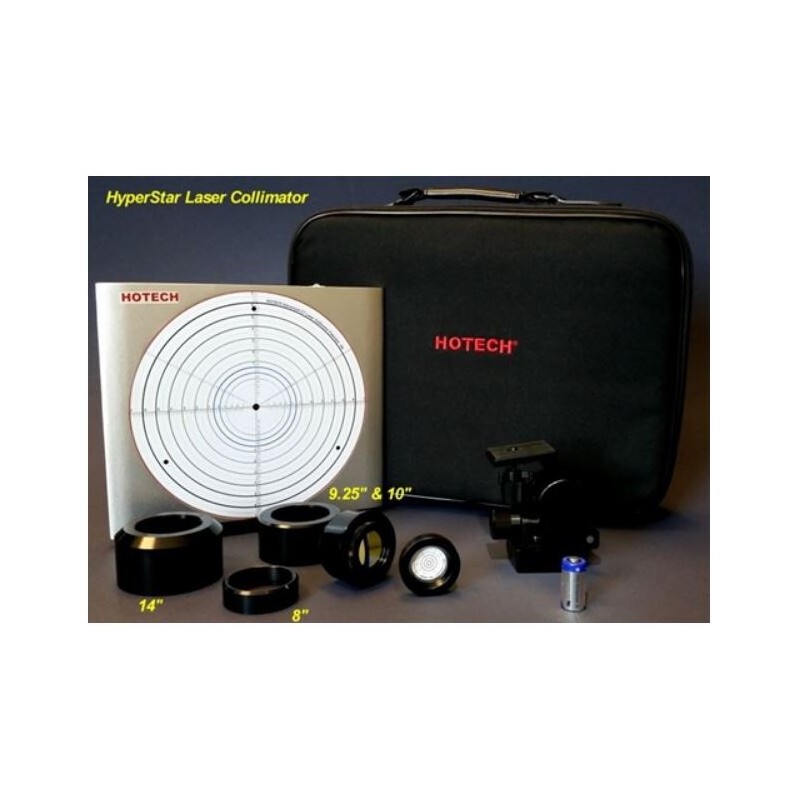
Included Items
-
Advanced CT Laser Collimator
-
14-inch HyperStar mirror adapters
-
One CR123 3V lithium battery
-
Carrying case with instruction manual
-
Fine adjustment unit
Technical Specifications
Connections and Power
-
Telescope connection: 1.25-inch
-
Laser diodes: 2
-
Maximum output power: 1 mW
-
Battery type: CR123 3V lithium
General Information
-
Product type: Alignment accessory
-
Design category: Laser alignment tool
Data sheet
Official permits of the Ministry of Development and Technology
Our company is involved in preparing official permits from the Polish Ministry of Development and Technology, which allows us to export all dual-use drones, optics, and portable radiophones without VAT on the Polish side / and without VAT on the Ukrainian side.