








Our company is involved in preparing official permits from the Polish Ministry of Development and Technology, which allows us to export all dual-use drones, optics, and portable radiophones without VAT on the Polish side / and without VAT on the Ukrainian side.
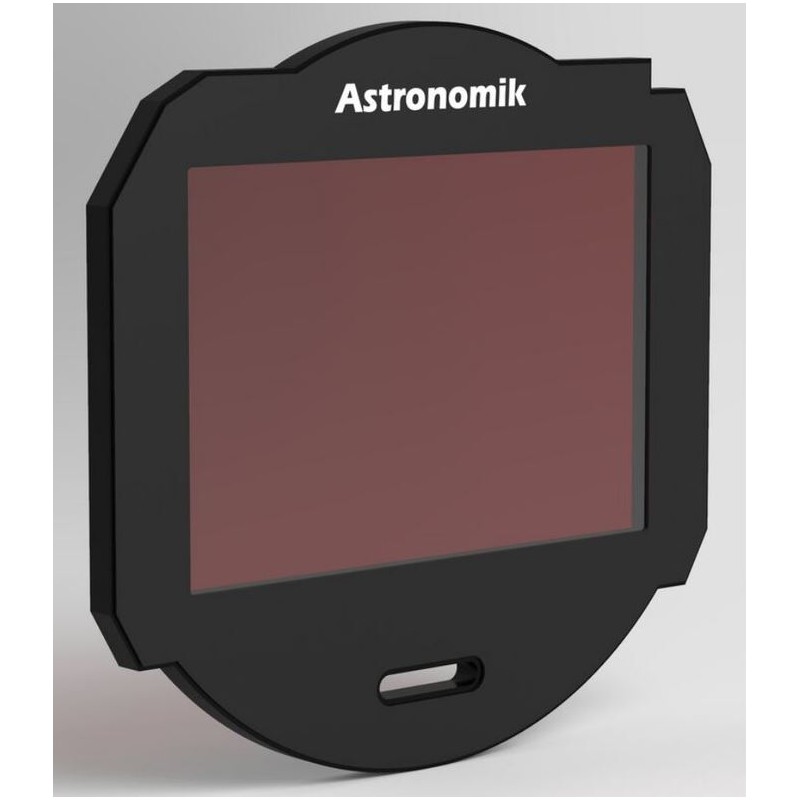
Astronomik Filters H-alpha 12nm MaxFR XT Clip Nikon Z XL (88411)
Astronomik XT filters for wide-angle optics are designed to deliver sharp, well-defined stars right into the corners of the image, even with extreme wide-angle lenses. With standard Astronomik filters, image quality at very short focal lengths can be limited. Although these filters use a glass substrate only one millimetre thick, certain wide-angle lenses can still introduce aberrations, causing stars near the edges of the frame to stretch into short lines.
471.95 $ net price (non-EU countries)
Karol Łoś
Product Manager
 /
/ 
+48603969934 +48507526097
[email protected]
Description
Astronomik XT filters for wide-angle optics are designed to deliver sharp, well-defined stars right into the corners of the image, even with extreme wide-angle lenses.
With standard Astronomik filters, image quality at very short focal lengths can be limited. Although these filters use a glass substrate only one millimetre thick, certain wide-angle lenses can still introduce aberrations, causing stars near the edges of the frame to stretch into short lines.
Astronomik XT filters solve this issue by using an ultra-thin carrier substrate only 0.3 millimetres thick. This significantly reduces edge distortions and minimizes star streaking in the corners of the image.
Despite their extremely thin construction, XT filters are finely polished, stress-free, and meet the highest quality standards demanded by astrophotographers worldwide.
Even with this ultra-thin glass, Astronomik XT filters use the same advanced coating technology found in all Astronomik filters. They are fully scratch-resistant, moisture-resistant, and non-ageing, ensuring that the filter retains 100% of its performance for many years.
Astronomik MaxFR filters are optimized for astrophotography with very fast optical systems, such as RASA telescopes and fast astrographs. For the three most important emission lines—OIII, H-alpha, and SII—the MaxFR series offers filter sets with 12 nm and 6 nm bandwidths.
These filters provide excellent out-of-band blocking across the entire spectrum from ultraviolet to infrared. The result is maximum contrast, minimal stray light, no halos, and exceptionally fine star images. With Astronomik MaxFR narrowband line filters, you obtain raw data of the highest quality, forming an ideal foundation for advanced image processing.
Transmission performance
-
12 nm bandwidth filters: Usable from f/1.7 to f/8 with approximately 85% maximum transmission
-
6 nm bandwidth filters: Usable from f/2.2 to f/8 with approximately 90% maximum transmission
The SII filter is optimized for especially high contrast by blocking H-alpha and NII (nitrogen) emission lines.
Astrophotography with narrowband line filters
Under bright or light-polluted skies, narrowband filters are an excellent entry point into astrophotography. An H-alpha filter is usually the first and most practical choice, allowing detailed imaging even under a full moon or very bright skies. It is suitable for all nebulae that emit red light.
The OIII filter expands imaging possibilities by revealing bluish and greenish structures with high contrast. Planetary nebulae and star-forming regions are particularly rewarding targets. Adding the SII filter completes an HSO filter set, enabling the creation of color images similar to those produced by the Hubble Space Telescope.
An H-beta filter is not offered in the 6 nm version, as it has little practical application.
Choosing the right bandwidth
Under dark skies, images taken with DSLRs and many cooled CCD cameras are often limited by camera dark current rather than sky brightness. In these cases, a narrower bandwidth does not necessarily reveal additional detail. The 12 nm filters therefore offer an advantage, as they make it easier to find guide stars, especially with cameras that use built-in guiding sensors.
For cameras with very low dark current and effective cooling, 6 nm filters provide clear benefits. Stronger suppression of sky background allows longer exposure times and deeper images. Stars become smaller, and faint stars are largely suppressed, making faint nebulae stand out clearly—even in dense Milky Way regions.
In summary, 12 nm filters are recommended for DSLRs and cameras with higher dark current, while 6 nm filters are ideal for heavy light pollution, very low-noise cameras, and maximum contrast imaging of faint objects.
Clip filter for Nikon Z full-frame mirrorless cameras
These clip filters are designed for Nikon Z5, Z6, and Z7 cameras. They sit securely and without tension inside the camera body and can be installed or removed quickly and easily. No camera modification is required.
The filters are optimized for use with both camera lenses and telescopes. Due to limited internal space, slight additional vignetting may occur with some lenses, which can be corrected using flat-field calibration. The filters are not compatible with the Nikon Z 2.0× teleconverter.
Specifications
-
Central wavelength: 656 nm
-
Half-value bandwidth: 12 nm
-
Mount type: Clip filter
-
Transmission: 96%
-
Mount material: Aluminium
-
Optical coating: MRF
-
Compatible cameras: Nikon
General information
-
Type: Filter
-
Design: Narrowband line filter
-
Series: MaxFR
Areas of application
-
Suitable for photography: Yes
-
Suitable for visual observation: No
-
Twin stars: No
-
Moon and planets: No
-
Nebulae and galaxies: Yes
Data sheet

Official permits of the Ministry of Development and Technology
Our company is involved in preparing official permits from the Polish Ministry of Development and Technology, which allows us to export all dual-use drones, optics, and portable radiophones without VAT on the Polish side / and without VAT on the Ukrainian side.