
 English
 Čeština
 Русский
 Deutsch
 Français
 Italiano
 Español
 Nederlands
 日本語
日本語 Svenska
 Dansk
Dansk Türkçe
 Bokmål
 中文
中文 Română
 български език
 Magyar
 Lietuvių kalba
 Slovenčina
 ελληνικά
 اللغة العربية
 Українська
 Suomi
Suomi Português PT
 Eesti keel
 עברית
עברית Latviešu valoda
 Slovenščina
 Hrvatski
 हिन्दी
 বাংলা
বাংলা Bahasa Indonesia
 繁體中文
繁體中文 한국어
한국어 Íslenska
 Tiếng Việt
 فارسى
فارسى ภาษาไทย

Our company is involved in preparing official permits from the Polish Ministry of Development and Technology, which allows us to export all dual-use drones, optics, and portable radiophones without VAT on the Polish side / and without VAT on the Ukrainian side.
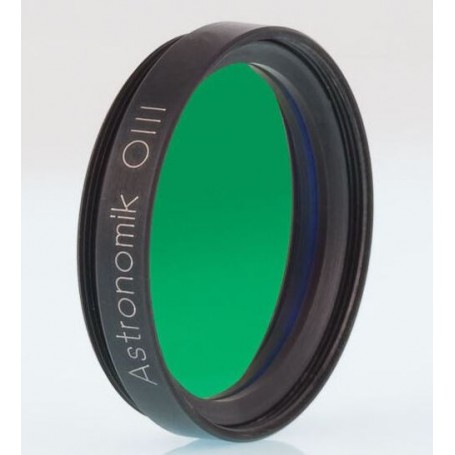
Astronomik Filters OIII 6nm CCD 1.25" (46796)
The OIII-CCD Filter is versatile, catering to imaging OIII nebulas from both light-polluted and dark observation sites, significantly enhancing contrast between objects emitting at 501nm and the background.
Karol Łoś
Product Manager /
/ 
+48603969934 +48507526097
[email protected]
The OIII-CCD Filter is versatile, catering to imaging OIII nebulas from both light-polluted and dark observation sites, significantly enhancing contrast between objects emitting at 501nm and the background.
With its narrow 6nm bandwidth and impressive 96% transmission, this filter provides a substantial contrast boost by effectively blocking unwanted light from UV to IR wavelengths, resulting in a remarkably dark background.
Tailored for optimal performance with CCD and CMOS sensors boasting very low dark current, the 6nm filter is perfect for observing from heavily light-polluted sites or imaging faint objects in densely populated areas of the Milky Way.
Please note: The Astronomik H-alpha filter MUST NOT BE USED for solar observation.
Key Features:
- Precise blocking of unwanted light from UV to IR
- Parfocal with all Astronomik filters
- Resistant to moisture and scratches, with no aging effects
- Optically polished substrate, devoid of striae and residual stresses
- Comes with a high-quality storage box
When used in conjunction with H-alpha-CCD and SII-CCD filters, the OIII-CCD filter enables the production of false-color emission line images (HSO) akin to those captured by the Hubble Space Telescope, even from heavily light-polluted sites.
Unlike purely visual filters, photographic CCD filters incorporate IR-blocking to mitigate optical issues caused by infrared radiation.
MFRF Coating: Utilizing the innovative MFRF coating technology, this filter can be employed on all devices up to an aperture of f/4.
Alternative: The 12nm line filters are ideal for DSLRs or CCD cameras with higher dark currents. They are also preferable for cameras with built-in guiding chips, offering twice as many stars in the image compared to the 6nm filter.
For your selection:
- Start with the Astronomik CLS filter to suppress artificial light pollution and airglow, allowing for longer exposure times and natural color reproduction. Note: The simple CLS filter lacks built-in IR-blocking, necessitating the CLS-CCD filter for astro-modified cameras.
- In heavily light-polluted areas, consider the Astronomik UHC filter for stronger background suppression, though it's best suited for gas nebulae rather than star clusters and galaxies.
- For detailed astrophotography, explore the OIII, H-alpha, and SII emission line filters, available in 6nm or 12nm bandwidths, enabling detailed imaging even in extreme light pollution.
- Owners of astro-modified cameras may benefit from the Astronomik OWB filter, correcting color reproduction for everyday photography without post-processing adjustments.
SPECIFICATIONS:
Capacity:
Central Wavelength (nm): 501
Transmission: 96%
Mount Material: Aluminium
Connection (to the telescope): 1.25"
Frame: 1.25"
Half-Value Width (nm): 6
General:
Series: OIII 6nm CCD
Type: Filters
Type of Build: Line filter
Area of Application:
Useful for Photographs: Yes
Galaxies and Star Clusters: Yes
Anti Light-Pollution: Yes
Visually Useful: No

Our company is involved in preparing official permits from the Polish Ministry of Development and Technology, which allows us to export all dual-use drones, optics, and portable radiophones without VAT on the Polish side / and without VAT on the Ukrainian side.