








Our company is involved in preparing official permits from the Polish Ministry of Development and Technology, which allows us to export all dual-use drones, optics, and portable radiophones without VAT on the Polish side / and without VAT on the Ukrainian side.
Celestron Origin II Telescope - Intelligent Home Observatory (12100) (88049)
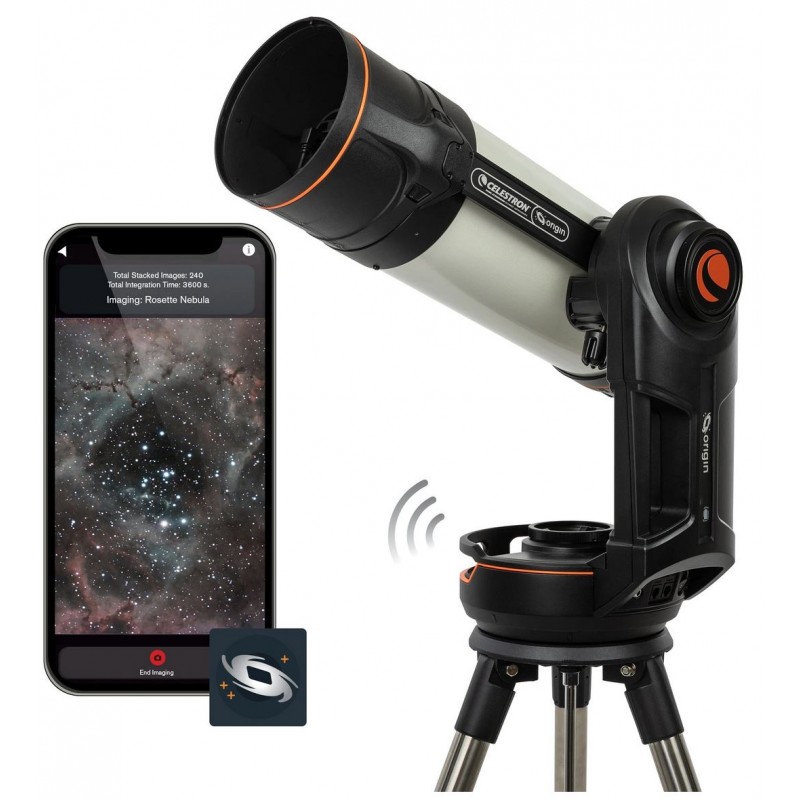
The Celestron Origin Mark II is an intelligent home observatory that combines a GoTo telescope, an ultra-fast astrograph, and a fully integrated imaging computer into a single, self-contained system. It is built around a 6-inch Rowe-Ackermann Schmidt Astrograph (RASA) operating at f/2.2, paired with the Celestron Origin 678C camera and an onboard computer controlled through a dedicated mobile app. The system delivers real-time, full-color views of galaxies, nebulae, and star clusters directly to a smartphone or tablet.
5000 $ net price (non-EU countries)
Anatolii Livashevskyi
Product Manager /
/ 
+48721808900 +48721808900
 +48721808900
[email protected]
Description
The Celestron Origin Mark II is an intelligent home observatory that combines a GoTo telescope, an ultra-fast astrograph, and a fully integrated imaging computer into a single, self-contained system. It is built around a 6-inch Rowe-Ackermann Schmidt Astrograph (RASA) operating at f/2.2, paired with the Celestron Origin 678C camera and an onboard computer controlled through a dedicated mobile app. The system delivers real-time, full-color views of galaxies, nebulae, and star clusters directly to a smartphone or tablet.
Designed as a true all-in-one solution, Origin Mark II automatically finds and tracks objects while performing deep-sky imaging without the need for external computers or complex setups. The fast 6-inch RASA optical system enables very short exposure times and a wide field of view, making it possible to capture detailed deep-sky objects in seconds rather than minutes. The integrated Origin 678C camera uses a Sony Starvis 2 color sensor with approximately 8.3 megapixels and 2.0-micron pixels, optimized for high sensitivity and fine detail.
Image processing is handled automatically by onboard, non-generative AI algorithms that align, stack, and enhance incoming frames in real time. This processing improves signal quality without inventing or colorizing data, ensuring that all visible details originate from real captured light. Automatic initialization is handled by StarSense technology, which completes autofocus and sky alignment in under two minutes.
Control is managed through a mobile app for iOS and Android, offering a planetarium-style sky view and a dynamically generated “Tonight’s Best” list based on location and time. Multiple devices can connect simultaneously for shared live viewing, and the live image stream can be displayed on a smart TV for group observing sessions. A built-in filter drawer accepts both 1.25-inch and 2-inch filters, making the system well suited for narrowband imaging and light pollution reduction.
The system supports exporting both raw image data and final stacked images via USB or WiFi for advanced post-processing. Fully automated, scheduled observations allow overnight imaging sessions without supervision. With an optional equatorial wedge and autoguiding accessories, the system can operate in equatorial mode for longer exposures without field rotation. In addition to astronomy, the system can also be used for terrestrial observation, offering strong low-light performance.
Power is supplied by an integrated 97.9 Wh LiFePO4 battery, providing approximately six hours of runtime, with support for external 12 V DC power for extended sessions.
Key features:
• All-in-one intelligent home observatory with automated object finding, tracking, and imaging
• 6-inch Rowe-Ackermann Schmidt Astrograph (RASA) at f/2.2 for ultra-fast imaging
• Integrated Origin 678C camera with Sony Starvis 2 color sensor (approx. 8.3 MP, 2.0 µm pixels)
• Real-time, non-generative AI image stacking and enhancement
• Automated autofocus and alignment with StarSense in under two minutes
• Mobile app control with planetarium view and curated observing lists
• Multi-user live viewing with support for screen casting
• Built-in filter drawer for 1.25-inch and 2-inch filters
• Raw and stacked image export via USB or WiFi
• Scheduled, unattended overnight imaging sessions
• Optional equatorial operation for longer exposures
• Suitable for terrestrial and low-light daytime use
• Integrated LiFePO4 battery with external power support
Optical system overview:
At the core of the system is a 6-inch RASA optical design operating at f/2.2. The camera is mounted at the front of the optical tube, producing a wide, well-corrected field with excellent sharpness across the frame. Compared to slower Newtonian reflectors or refractors, this design captures significantly more light in a shorter time, allowing deep-sky details to be revealed with exposures as short as 10 to 15 seconds.
The optics use high-transmission StarBright XLT coatings and feature a 63 mm central obstruction, corresponding to 41% of the aperture diameter. This configuration provides even field illumination and strong performance both under light-polluted skies with filters and at dark-sky locations without filtration.
Camera and image processing:
The integrated Origin 678C camera is based on a back-illuminated Sony IMX678 Starvis 2 CMOS sensor. With 2.0-micron pixels and a field of view of approximately 1.32° by 0.75°, the camera captures subtle galaxy structures and faint nebular detail when paired with the fast RASA optics.
As data is collected, onboard software automatically aligns and stacks frames in real time. Users can rely on fully automatic settings or manually adjust brightness, contrast, color saturation, and stretch strength before saving or exporting images.
Control and automation:
The system is controlled through a dedicated mobile app that provides intuitive object selection directly from a sky map. StarSense technology handles sky recognition and alignment automatically, without the need for manual star centering. Once an object is selected, the system centers it precisely and begins continuous short exposures while actively preventing dew formation on the optics.
Live stacking progress can be monitored on the mobile device, and multiple users can view the same live feed at once. The system includes automated dew control and cooling to maintain consistent performance during long observing sessions.
Solar safety guidelines:
• Never look directly at the Sun with the naked eye or through the telescope without a proper solar filter
• Never project an image of the Sun onto any surface, as internal heat buildup can damage optics and accessories
• Always ensure the telescope is operated by an experienced adult, especially when children are present
Included accessories:
• 6-inch RASA optical tube with integrated Origin 678C camera
• Single fork-arm GoTo mount with built-in computer and battery
• Full-height tripod
• Integrated autofocus system
• Automated dew prevention system with heater, removable shield, and environmental sensor
• Integrated filter drawer for 1.25-inch and 2-inch filters
• Cooling fans for optics and electronics
• Front dust cover
• 12 V DC power adapter for charging and external operation
Technical specifications:
• Optical design: Rowe-Ackermann Schmidt Astrograph
• Aperture: 152 mm (5.98 inches)
• Focal length: 335 mm
• Focal ratio: f/2.2
• Optical coatings: StarBright XLT
• Central obstruction: 63 mm (41% of aperture)
• Light-gathering power: 474× the human eye
• Image scale: 1.48 arcseconds per pixel
• Dovetail: CG-5 style
• Filter support: Integrated drawer for 1.25-inch and 2-inch filters
• Image sensor: Sony IMX678 color, back-illuminated CMOS
• Sensor diagonal: 8.9 mm
• Pixel size: 2.0 µm × 2.0 µm
• Resolution: 3856 × 2180 pixels (8.3 MP)
• Field of view: Approximately 1.32° × 0.75°
• Onboard computer: Raspberry Pi 4 Model B
• Mount type: Computerized GoTo alt-azimuth, single fork-arm
• Dew control: Fully automated front-lens heater and removable shield
• Focus system: Motorized autofocus with manual override
• Cooling: Dedicated fans for optics and electronics
• Status indication: Integrated LED status ring
• Connectivity: Multiple USB-A, Ethernet, and auxiliary ports
• Internal battery: Integrated LiFePO4, 97.9 Wh
• Typical runtime: Over 6 hours, depending on conditions
• External power: 12 V DC input
• Supported platforms: iOS 16 or newer, Android 12 or newer
• Optical tube dimensions: 609.6 × 177.8 mm
• Mount dimensions: 457.2 × 304.8 × 254 mm
• Tripod dimensions (collapsed): 330.2 × 304.8 × 812.8 mm
• Fully assembled dimensions: 609.6 × 660.4 × 1219.2 mm
• Optical tube weight: 4.8 kg
• Mount weight: 7.7 kg
• Tripod weight: 6.35 kg
• Total system weight: 18.87 kg
Data sheet
Official permits of the Ministry of Development and Technology
Our company is involved in preparing official permits from the Polish Ministry of Development and Technology, which allows us to export all dual-use drones, optics, and portable radiophones without VAT on the Polish side / and without VAT on the Ukrainian side.