








Our company is involved in preparing official permits from the Polish Ministry of Development and Technology, which allows us to export all dual-use drones, optics, and portable radiophones without VAT on the Polish side / and without VAT on the Ukrainian side.
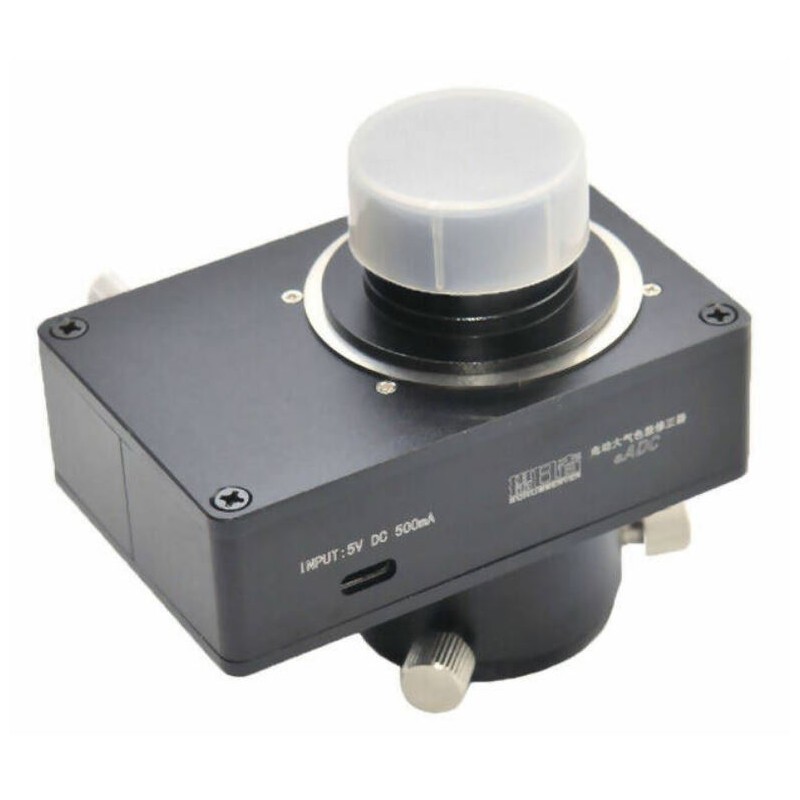
Artesky eADC Electronic Atmospheric Dispersion Corrector V3 (88181)
The SunObserver eADC V3 is a third-generation electric atmospheric dispersion corrector featuring zero image shift technology, designed for demanding astrophotography and high-precision visual observation. At the core of the eADC V3 is a system of four prisms arranged in two groups, made from high-quality optical glass and treated with broadband anti-reflective coatings. An integrated sensor continuously detects the telescope’s orientation and automatically calculates the required atmospheric dispersion correction.
687.65 $ net price (non-EU countries)
Anatolii Livashevskyi
Product Manager /
/ 
+48721808900 +48721808900
 +48721808900
[email protected]
Description
The SunObserver eADC V3 is a third-generation electric atmospheric dispersion corrector featuring zero image shift technology, designed for demanding astrophotography and high-precision visual observation.
At the core of the eADC V3 is a system of four prisms arranged in two groups, made from high-quality optical glass and treated with broadband anti-reflective coatings. An integrated sensor continuously detects the telescope’s orientation and automatically calculates the required atmospheric dispersion correction. This works even during meridian flips, eliminating the need for manual realignment.
In addition to automatic operation, the dispersion correction can also be adjusted manually using the built-in control knob.
What is an Atmospheric Dispersion Corrector (ADC)?
Light from stars and planets is refracted as it passes through the Earth’s atmosphere. This refraction varies with wavelength, an effect known as atmospheric dispersion. As a result, color fringing appears along the edges of planetary discs, similar to chromatic aberration in a telescope lens. Even high-quality telescopes without intrinsic chromatic aberration are affected, as atmospheric dispersion cannot be corrected by the telescope optics alone.
An ADC compensates for this effect using rotatable prisms made of optical glass. These prisms introduce controlled chromatic aberration that is opposite to atmospheric dispersion, effectively canceling it out. In conventional ADCs, the relative prism positions are adjusted manually. The eADC V3 automates this process while maintaining precision.
Who benefits from an ADC?
The strength of atmospheric dispersion depends heavily on the altitude of the observed object. Objects closer to the horizon pass through more atmosphere, resulting in stronger dispersion. Bright planets are often observed at low elevations, particularly at higher latitudes.
An ADC allows planets to be observed with high sharpness, color accuracy, and contrast, even when they are rising or setting. This greatly expands the range of usable observing times.
While color fringing is the most noticeable effect, atmospheric dispersion also reduces image contrast, which is especially problematic in astrophotography. Although contrast can be enhanced during image processing, this usually comes at the expense of resolution. For this reason, an ADC is a valuable accessory for planetary imaging. The eADC V3 includes T2 connections on both sides, making it ideal for imaging setups.
The optical surfaces feature specialized coatings that ensure very high light transmission, optimized for wavelengths between 300 and 700 nanometres, a range particularly well suited for astrophotography.
Specifications
-
Camera-side connection: T2
-
Telescope-side connection: T2
-
Optical coating: Multi-layer
-
Glass material: CDGM F4 and H-ZK9B
-
Passband: 350–700 nm
-
Clear aperture: 22 mm
-
Input voltage: 5 V (USB)
-
Power consumption: 400 mA
-
Number of optical groups: 2
-
Number of lenses: 4
-
Optical length: 22 mm
Equipment
-
Barrel adapter: 1.25 inch
General information
-
Weight: 267 g
-
Housing material: Aluminium
-
Dimensions (L × W × H): 59.0 × 89.6 × 80.4 mm
-
Suitable for visual observation: Yes
-
Suitable for astrophotography: Yes
Data sheet
Official permits of the Ministry of Development and Technology
Our company is involved in preparing official permits from the Polish Ministry of Development and Technology, which allows us to export all dual-use drones, optics, and portable radiophones without VAT on the Polish side / and without VAT on the Ukrainian side.