







Our company is involved in preparing official permits from the Polish Ministry of Development and Technology, which allows us to export all dual-use drones, optics, and portable radiophones without VAT on the Polish side / and without VAT on the Ukrainian side.
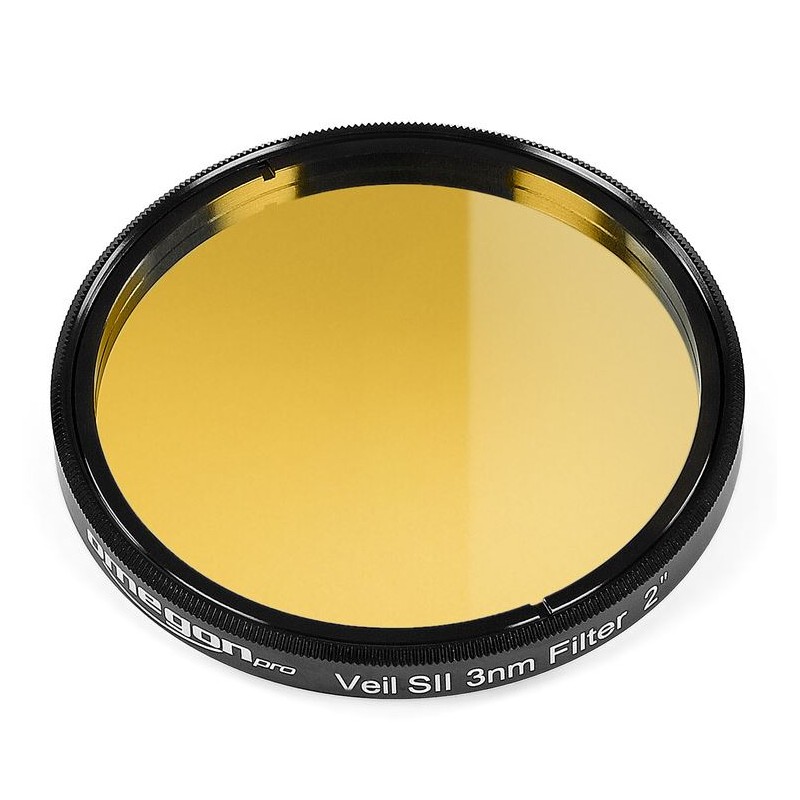
Omegon Filters Pro Veil SII 3nm 2'' (82013)
Artificial lighting in populated areas brightens the night sky and reduces contrast, making faint deep-sky objects difficult to detect. Skyglow from streetlights and other sources often masks delicate nebular structures. Emission nebulae differ from galaxies, globular clusters and reflection nebulae because they emit light at very specific wavelengths. While the human eye is primarily sensitive to the O-III and H-Beta lines, cameras can record all of these wavelengths, including the deep red emissions of hydrogen and ionised sulphur.
315.84 $ net price (non-EU countries)
Anatolii Livashevskyi
Product Manager /
/ 
+48721808900 +48721808900
 +48721808900
[email protected]
Description
Omegon Filters Pro Veil SII 3 nm 2" (82013)
Artificial lighting in populated areas brightens the night sky and reduces contrast, making faint deep-sky objects difficult to detect. Skyglow from streetlights and other sources often masks delicate nebular structures.
Emission nebulae differ from galaxies, globular clusters and reflection nebulae because they emit light at very specific wavelengths. The most prominent emission lines include:
-
H-Alpha: 656.3 nm
-
H-Beta: 486.1 nm
-
O-III: 495.9 nm and 500.7 nm
-
S-II: 671.7 nm and 673.1 nm
While the human eye is primarily sensitive to the O-III and H-Beta lines, cameras can record all of these wavelengths, including the deep red emissions of hydrogen and ionised sulphur.
The Omegon Pro Veil SII 3 nm filter is a narrowband filter designed to isolate the SII emission lines at 671.7 nm and 673.1 nm. With a very narrow bandwidth of 3 nm, it effectively suppresses artificial light pollution while transmitting the sulphur-II lines with high efficiency.
These wavelengths are characteristic of many planetary nebulae, emission nebulae and supernova remnants. By isolating the SII signal, the filter enhances contrast and reveals fine structural details within these objects.
For astrophotography, monochrome cameras are recommended to achieve the best results. Combining exposures taken with SII, OIII and H-Alpha filters allows the creation of high-contrast composite images that clearly display intricate nebular structures.
Technical Specifications
Frame size: 2-inch
Eyepiece connection: 2-inch
Central wavelength: SII 671.7–673.1 nm
Bandwidth (half-value width): 3 nm
Material: Glass
Type: Filter
Design: Narrowband (UHC-type)
Series: Veil
Data sheet

Official permits of the Ministry of Development and Technology
Our company is involved in preparing official permits from the Polish Ministry of Development and Technology, which allows us to export all dual-use drones, optics, and portable radiophones without VAT on the Polish side / and without VAT on the Ukrainian side.