List of products by brand Hotech

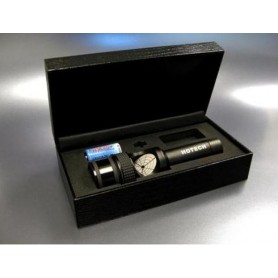
Hotech 1.25" SCA laser collimator - crosshair laser (22956)
305.49 $
Tax included
Say goodbye to the frustration of loose-fitting laser collimators! Our innovative Self-Centering Adapter, featuring expanding rubber rings, eliminates sloppiness. Each ring expands to fill the focuser slop, precisely centering the laser collimator in the drawtube. Compatible with most focuser brands, our SCA ensures consistent installation for precise collimation every time.
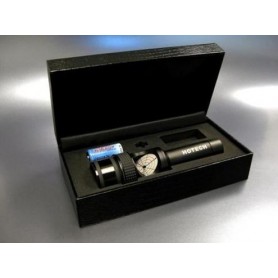
Hotech 1.25" SCA laser collimator - dot laser (22954)
265.47 $
Tax included
Tired of dealing with loose laser collimators? Our innovative Self-Centering Adapter tackles this issue head-on with expanding rubber rings, eliminating sloppiness. As each ring expands, it fills the focuser slop and precisely centers the laser collimator in the drawtube. Compatible with most focuser brands, our SCA ensures consistent and accurate collimation installation every time.
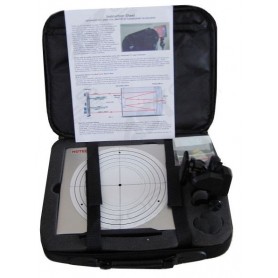
Hotech 1.25"/2" SCA laser collimator - dot laser (22955)
259.13 $
Tax included
The HoTech laser collimator stands apart with its revolutionary Self-Centering Adapter (SCA) technology. This mechanism ensures precise and consistent installation across all 1.25" and 2" telescope focusers, guaranteeing accurate collimation. Unlike traditional collimators, which often suffer from sloppiness in the adapting mechanism, the SCA cleverly eliminates this issue by employing expanding rubber rings.
Hotech 2" SCA laser collimator - crosshair laser (22957)
272.08 $
Tax included
Say goodbye to the frustration of loose-fitting laser collimators! Our patented Self-Centering Adapter tackles this issue head-on by employing expanding rubber rings. These rings expand to fill the focuser slop, precisely centering the laser collimator in the drawtube. This mechanism, compatible with most focuser brands, ensures consistent installation for accurate collimation.
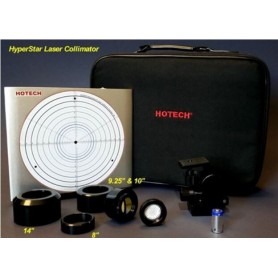
Hotech HyperStar Laser Collimator 8" (64548)
858.39 $
Tax included
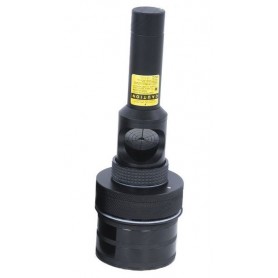
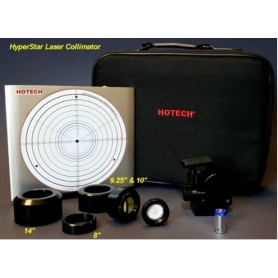
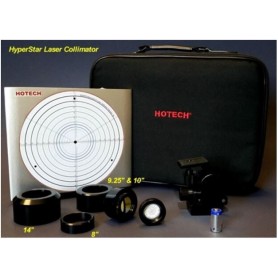
The Hotech HyperStar Laser Collimator 8" is a precision alignment tool designed for Schmidt-Cassegrain (SC) telescopes with a 200mm (8 inch) aperture, specifically those equipped with a HyperStar system. This patented laser collimator allows for quick and highly accurate optical alignment indoors, eliminating the need for a star during the collimation process. With this device, you can align your entire optical train at the final viewing setting, saving valuable observing time and ensuring peak performance from your telescope.
Hotech 2" SCA field flattener (22937)
402.41 $
Tax included
Refractor telescopes often produce optical errors toward the edge of the image field. This leads to field curvature, where stars near the edges appear blurred, distorted, or out of focus. Such curvature reduces image quality and is especially undesirable in astrophotography, where visual aesthetics and pinpoint stars matter. The Hotech Field Flattener offers a simple and effective solution to this common issue. Achieving sharp stars right to the corners of the image is possible with the Hotech Field Flattener—and it is remarkably easy to use.
Hotech HyperStar Laser Collimator 14" (64686)
999.45 $
Tax included
Achieving precise star collimation normally requires ideal conditions: clear skies, no wind, stable temperatures, minimal light pollution, a well-aligned tracking mount, thermal equilibrium of the optical tube, and a suitably bright reference star. In reality, these factors are rarely all present at the same time. As a result, traditional star collimation often becomes a frustrating trial-and-error process, moving back and forth between the front and rear of the telescope, adjusting screws while trying to judge concentricity through a high-magnification eyepiece as the defocused star image constantly shifts.
Hotech HyperStar Laser Collimator 9.25" / 11" (64685)
999.45 $
Tax included
Achieving precise star collimation typically demands ideal observing conditions: clear skies, calm air, stable temperatures, minimal light pollution, a well-aligned tracking mount, thermal equilibrium of the optical tube, and a suitably bright reference star. In practice, many of these factors are beyond the observer’s control. As a result, traditional star collimation often turns into a frustrating guessing game—moving between the front and back of the telescope, adjusting screws while peering through a high-magnification eyepiece at an unstable, defocused star image. The process can be time-consuming and unreliable.