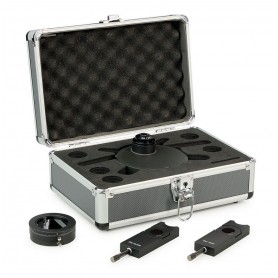
Magus DIC290 Attachment Set (85108)
3713.12 £
Tax included
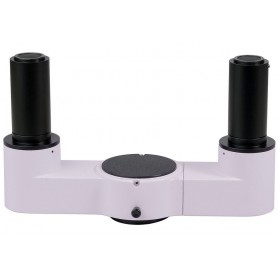
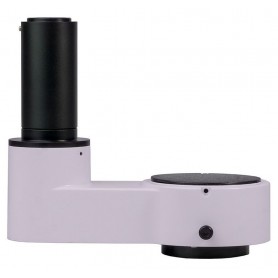
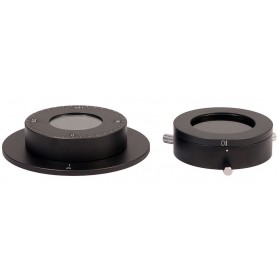
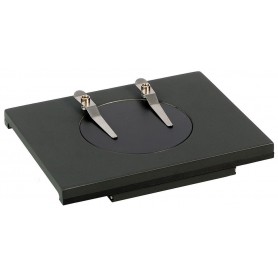
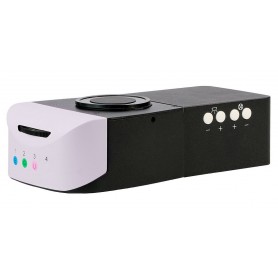
The differential interference contrast (DIC) device is designed for studying transparent, low-contrast specimens that are difficult or impossible to observe using standard bright-field microscopy. This technique enhances image resolution and clarity through optical methods rather than chemical staining, while also providing additional structural information about the specimen. The DIC method creates a pseudo-relief effect, giving the image an apparent three-dimensional appearance. 
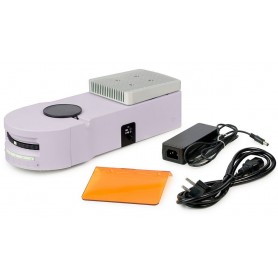
Magus Epi-FL05 LED Epi-Fluorescence Attachment, fluorescence filter cubes B/G/UV/R (85158)
4400.14 £
Tax included
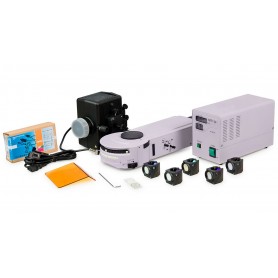
The epi-fluorescence attachment enables the use of the fluorescence technique, which relies on the ability of certain substances to emit light when excited by light of a specific wavelength. Some specimens display natural autofluorescence, while others require treatment with fluorochromes to produce a fluorescent signal. The attachment is installed in the optical path between the microscope stand and the head. Inside the unit is a five-position rotating turret containing four fluorescence filters with different wavelength ranges: broad-band blue (B), green (G), ultraviolet (UV), and narrow-band red (R).
Magus SCH4 Bio V360 Labware Holder Set (85126)
312.23 £
Tax included
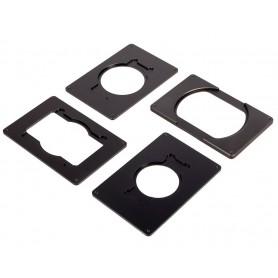
This professional holder set is designed to securely fix labware of various shapes when working with an inverted microscope. It ensures stable positioning of dishes and provides convenience during sample replacement. The set includes four holders intended for culture bottles and similar labware. Each holder features two seating sizes, allowing compatibility with two standard labware dimensions. The holders are installed directly into the microscope stage according to the shape and size of the accessory being used.
Magus CEI A18 LED Episcopic Light with power supply and objective insert (85127)
1687.28 £
Tax included
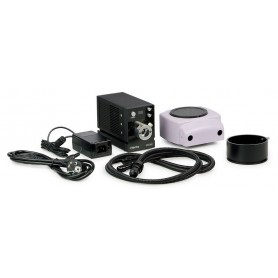
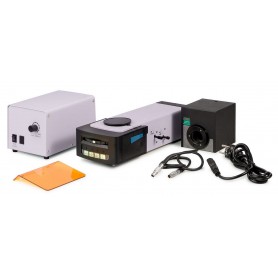
Episcopic illumination provides bright, uniform, and shadow-free lighting of the field of view without causing heat damage to the specimen. It is specifically used for illuminating opaque objects in stereomicroscopy. The attachment is installed between the microscope head and the zoom objective. The light source is housed in a dedicated lamphouse, which is connected to the attachment by a flexible dual light guide. Light is delivered through the guide into the attachment and then directed to the sample through the objective. 
Magus CLI18T Cold Light with dual light guide (85128)
887.64 £
Tax included
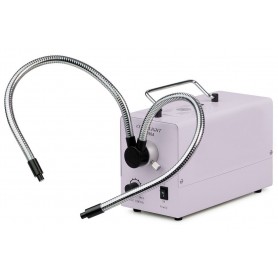
The MAGUS CLI18T illuminator is designed to illuminate samples with oblique light, making it possible to clearly visualize surface relief, scratches, cracks, and other defects through pronounced highlights and shadows. The design of the illuminator prevents sample heating and eliminates the risk of thermal damage. The light source is housed in a dedicated lamphouse. Light is directed to the specimen through a flexible dual light guide. The position of the light guide can be adjusted to set the desired illumination angle, allowing precise control over light and shadow formation for detailed examination. 
Magus LED RL18T Ring Light (85129)
207.31 £
Tax included
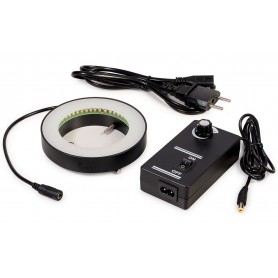
This LED ring light with a matte diffuser is designed to provide bright, uniform, and shadow-free reflected illumination. It is mounted directly onto the CMO stereomicroscope objective, allowing the light to be delivered coaxially. This illumination method is particularly important when observing flat, glossy, or low-contrast samples. The matte diffuser effectively removes harsh shadows and significantly reduces glare, producing soft and evenly distributed light. The LEDs require no warm-up time, reaching the selected brightness instantly and maintaining a stable color temperature even during extended use.
Magus BTP A10 Beamsplitter with two ports (85142)
761.55 £
Tax included
The CMO (Common Main Objective) system allows additional accessories to be integrated into the optical path. A two-port beamsplitter is installed between the microscope head and the zoom objective, enabling the simultaneous use of two digital cameras. A stereomicroscope with a CMO design produces high-quality digital images without field distortion. This makes it an excellent choice for photo and video recording, as well as for presentations and lectures that rely on visual materials.
Magus BOP A10 Beamsplitter with one port (85143)
394.31 £
Tax included
The CMO (Common Main Objective) system allows additional accessories to be incorporated into the optical path. A beamsplitter with a single port is mounted between the microscope head and the zoom objective and is used for installing a digital camera. A stereomicroscope built with a CMO design produces high-quality digital images without field distortion. This makes it well suited for photo and video recording, as well as for presentations and lectures that rely on visual demonstrations.
Magus SPD A10 Polarizer/Analyzer Set (85146)
169.23 £
Tax included
This polarizer and analyzer set is designed to enable polarized light techniques. It includes a polarizer and an analyzer, and the intensity of transmitted light varies depending on their relative orientation. When the polarizer and analyzer are positioned perpendicular to each other, complete light extinction occurs. Polarized light is used to study anisotropic samples such as geological specimens, biological structures, and polymer materials.
Magus XY A10 Mechanical Stage for stereomicroscopes (85148)
236.92 £
Tax included
The stage is mounted in the base of the stereomicroscope and is used for precise and smooth movement of the sample beneath the objective, as well as for documenting observations with a camera. Coaxial control knobs allow controlled movement of the specimen along the X axis (right and left) and the Y axis (forward and backward). The transparent glass surface of the stage enables work with both reflected and transmitted light. A vernier scale is provided for precise measurement along a single axis.
Magus FM4 A10 Focus Mount (85150)
169.23 £
Tax included
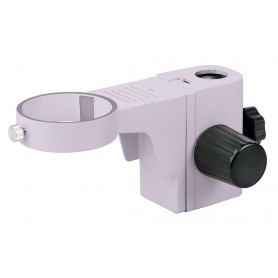
The focusing mechanism is a structural component of the stereomicroscope designed to secure the microscope head to the stand. It enables precise vertical movement of the microscope head, allowing accurate focusing on the specimen. Focus adjustment is performed using coaxial knobs, which provide smooth and controlled operation during observation.
Magus Epi-FL04M LED Epi-Fluorescence Attachment, fluorescence filter cubes B/G/UV (85153)
5220.95 £
Tax included
The epi-fluorescence attachment is designed to enable fluorescence microscopy. This technique relies on the ability of certain substances to emit light when excited by illumination at a specific wavelength. Some specimens naturally exhibit autofluorescence, while others require treatment with fluorochromes to produce a fluorescent signal. The attachment is installed in the optical path between the microscope head and the stand. Inside the unit is a four-position rotating turret that holds three broadband fluorescence filter sets for blue (B), green (G), and ultraviolet (UV) excitation.
Magus Epi-FL04 LED Epi-Fluorescence Attachment, fluorescence filter cubes FITC/TRITC/DAPI (85156)
6143.28 £
Tax included
The epi-fluorescence attachment is designed for fluorescence microscopy. This technique is based on the ability of certain substances to emit light when excited by illumination at a specific wavelength. Some specimens show natural autofluorescence, while others require staining with fluorochromes to produce a fluorescent signal. The attachment is installed in the optical path between the microscope head and the stand. Inside the unit is a four-position rotating turret equipped with three narrow-band fluorescence filter sets for the fluorochromes DAPI, FITC, and TRITC. 
Magus Epi-FL06 Epi-Fluorescence Attachment, mercury lamp, fluorescence filter cubes В/G/UV/V/R/FITC/TRITC/DAPI (85157)
7564.87 £
Tax included
The epi-fluorescence attachment is designed for fluorescence microscopy. This technique is based on the ability of certain substances to emit light when excited by illumination at a specific wavelength. Some specimens naturally exhibit autofluorescence, while others require treatment with fluorochromes to produce a visible fluorescent signal. The attachment is installed in the optical path between the microscope head and the stand. Inside the unit is a six-position rotating turret fitted with fluorescence filters.
Paton Hawksley Hand spectroscope (44959)
77.17 £
Tax included
This transmitted light spectroscope is a simple yet precise instrument designed for observing and analyzing the spectra of various light sources. It features a tube with a precision entrance slit and a 600 lines-per-millimetre grating, allowing users to easily point it at different light sources such as the sky (to observe the solar spectrum and Fraunhofer absorption lines), flames for chemical analysis, liquids for their absorption spectra, or the bright lines from discharge tubes and lamps.
Starlight Xpress Spectroscope SX with Lodestar X2 Autoguider (48690)
3958.66 £
Tax included
This compact spectroscope features a high-performance flat-field concave grating in a module measuring just 136 x 120 x 75 mm and weighing 1.2 kg. It includes a built-in Lodestar X2 guide camera and an argon-neon calibration lamp for precise wavelength calibration. Both the input and output are equipped with T2 threads, making the unit compatible with most imaging cameras that use T2 thread connections. Starlight Xpress recommends pairing this spectroscope with the Trius SX-694 camera for optimal performance.