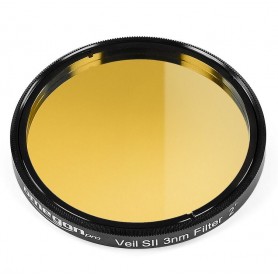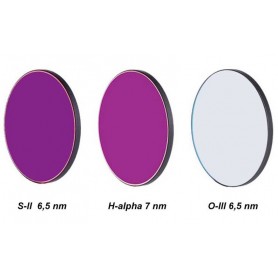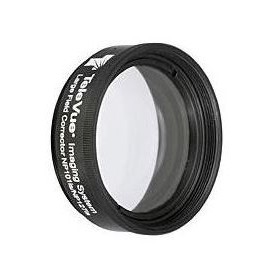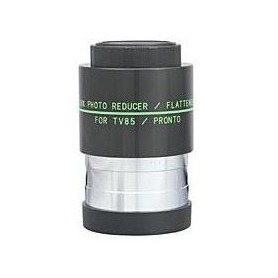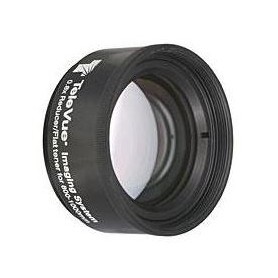

Askar Filters Colour Magic SII 3nm 2" (87815)
444.45 $
Tax included
The ColourMagic 3 nm Narrowband Filter features an extremely narrow bandwidth combined with excellent light transmission, allowing the capture of high-contrast, low-noise deep-sky images even in locations affected by urban light pollution, atmospheric airglow, or other unwanted light sources. This performance makes faint nebular structures and subtle stellar details, which are often difficult to detect, clearly visible. In addition, the ColourMagic filter incorporates an optimized optical design for effective halo control, ensuring higher image quality and enhancing the overall expressive power of astrophotography.
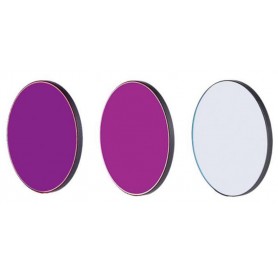
Askar Filters Colour Magic H-alpha SII OIII 3nm 2" (87817)
1168.42 $
Tax included
The ColourMagic 3 nm Narrowband Filter set features an extremely narrow bandwidth combined with excellent light transmission, allowing the capture of high-contrast, low-noise deep-sky images even in environments affected by urban light pollution, atmospheric airglow, or other stray light sources. This performance makes faint nebular structures and subtle stellar details, which are often difficult to reveal, clearly visible. In addition, the ColourMagic filters use an optimized optical design for effective halo control, resulting in higher image quality and greater expressive power in astrophotography.
Askar Flattener 1.0x 10³APO (86169)
252.01 $
Tax included
A field flattener is an optical lens designed to correct the slight curvature of the image field produced by a telescope’s primary optics. This natural curvature causes stars near the edges of the field of view to appear less sharp. By correcting this effect, the flattener ensures that stars remain sharp and well-defined across the entire image, from center to edge.
Askar Flattener 1.0x 120APO (88205)
261.17 $
Tax included
A field flattener is an optical element designed to correct the slight curvature of the image field produced by a telescope’s primary optics. This natural curvature causes stars near the edges of the image to appear softer or out of focus. By compensating for this effect, the flattener ensures that stars remain sharp and well-defined across the entire field of view, from the center to the edges of the frame.
Askar Flattener 1.0x 160 f/7 (87467)
451.33 $
Tax included
A field flattener is an optical lens designed to correct the slight curvature of the image field produced by a telescope’s primary optics. This inherent curvature causes stars near the edges of the field of view to appear less sharp. By compensating for this effect, the flattener ensures that stars remain sharp and well-defined across the entire image, from the center to the outer edges of the frame.
Askar Reducer 0.8x 120APO (88179)
261.17 $
Tax included
A focal reducer shortens the effective focal length of a telescope, making the optical system faster for astrophotography. This results in a brighter image and a wider field of view, allowing larger areas of the sky to be captured in a single exposure.
Astronomik Filters H-alpha 12nm MaxFR XT Clip Nikon Z XL (88411)
471.95 $
Tax included
Astronomik XT filters for wide-angle optics are designed to deliver sharp, well-defined stars right into the corners of the image, even with extreme wide-angle lenses. With standard Astronomik filters, image quality at very short focal lengths can be limited. Although these filters use a glass substrate only one millimetre thick, certain wide-angle lenses can still introduce aberrations, causing stars near the edges of the frame to stretch into short lines.
Baader Filters D-ERF energy protection filter 290 mm (87870)
5315.17 $
Tax included
Plano-parallel round optical discs with both surfaces precision-polished to lambda/10 accuracy ensure excellent optical quality. An advanced infrared anti-reflection coating, based on a multi-layer dielectric interference system, prevents excessive heat from entering the telescope’s optical tube assembly. The plano-parallel D-ERF (Energy Rejection Filter) effectively blocks infrared radiation, even during extended observing sessions.
DayStar Solar filters QUARK Gemini Combo H-Alpha (87882)
2886.68 $
Tax included
The DayStar Quark Gemini combines both Prominence and Chromosphere bandpass filters in a single unit, allowing instant switching between the two views using a simple slide mechanism. Observers can now enjoy the strengths of both bandpasses in one easy-to-use tool, with no need to change equipment or refocus. By sliding the control arm side to side—much like during an eye exam—you can transition from the broader bandpass view, which highlights large, dramatic solar prominences, to the narrower bandpass view, delivering high-contrast detail of chromospheric features.
Dwarflab Smart Telescope AP 30/150 mini (88212)
550 $
Tax included
The DWARF mini sets a new benchmark for portability in the world of smart telescopes. With a weight of just 840 grams, it is currently the lightest model in its class, while still delivering the convenience and performance expected from a modern, intelligent telescope. Compact, powerful, and intuitive, it is designed to make astronomy accessible almost anywhere. Within minutes, the DWARF mini is ready to explore the night sky. It automatically calibrates itself, locates selected celestial objects, and keeps them precisely centered.
Hotech 2" SCA field flattener (22937)
280.11 $
Tax included
Refractor telescopes often produce optical errors toward the edge of the image field. This leads to field curvature, where stars near the edges appear blurred, distorted, or out of focus. Such curvature reduces image quality and is especially undesirable in astrophotography, where visual aesthetics and pinpoint stars matter. The Hotech Field Flattener offers a simple and effective solution to this common issue. Achieving sharp stars right to the corners of the image is possible with the Hotech Field Flattener—and it is remarkably easy to use.
IDAS Filters NGS1 2" (62321)
230.92 $
Tax included
IDAS Night Glow & LPS Filters improve the contrast of astronomical emission nebulae against skies affected by both artificial and natural sky glow, while maintaining accurate color balance for broadband objects such as galaxies. Like other IDAS interference filters, the bandpass design accommodates the steep light angles produced by fast optical systems.
iOptron Filters OIII 1.25" (87504)
221.78 $
Tax included
This narrowband line filter is designed for astrophotography, specifically to enhance the visibility of emission nebulae by isolating key oxygen emission lines. By suppressing unwanted background light, it increases contrast and reveals fine structural details in nebulae. The filter is optimized for imaging rather than visual observing and is best suited for deep-sky photography under light-polluted or dark-sky conditions.
iOptron Filters SII 1,25" (87502)
221.78 $
Tax included
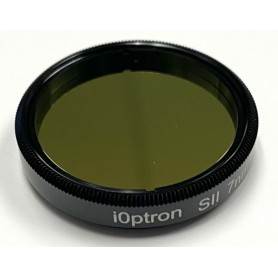
The SII narrowband filter is designed for nebula astrophotography and transmits light centered at a wavelength of 672 nm. With a narrow bandpass, it enhances contrast and isolates sulfur emission, making it well suited for imaging emission nebulae, planetary nebulae, and supernova remnants. For astrophotographers seeking the classic Hubble Space Telescope–style appearance, such as the iconic “Pillars of Creation” in the Eagle Nebula (Messier 16), the SII filter is a natural addition after H-alpha and OIII filters. Like H-alpha, SII operates in the deep red region of the spectrum near 672 nm.
Vaonis Smart Telescope AP 50/250 Vespera II High Carbon Tripod (86779)
1735.64 $
Tax included
Vespera II represents the next step in the evolution of its predecessor. It combines a telescope and a camera into one intelligent, fully automated observation station. Designed for ease of use, it makes exploring the night sky accessible to everyone. Users can observe celestial objects, capture their own astrophotography, learn about space, and share discoveries through a single integrated system. If you have ever wanted to photograph the stars, Vespera II allows you to do so at the touch of a button.
Lunt Solar Systems Solar telescope ST 100/714 LS100MT FT Ha B3400 Allround OTA (78018)
11000 $
Tax included
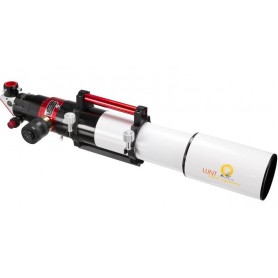
The LS100MT is a complete solar telescope designed for observing the Sun in H-alpha light. It features a 100 mm clear aperture with no central obstruction and a focal length of 714 mm. Observing the Sun at the H-alpha wavelength reveals striking details such as prominences along the solar limb, filaments, flares, and dynamic surface activity. An internal etalon filter with an advanced air pressure tuning system achieves a bandwidth of less than 0.7 angstrom, delivering high-contrast solar views.
Omegon Apochromatic Refractor Pro APO AP 71/490 Quadruplet OTA (85631)
738.49 $
Tax included
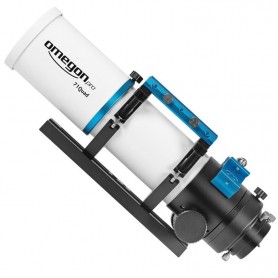
The Omegon Pro APO AP 71/490 Quadruplet is designed for astrophotographers who want sharper images, accurate colours and a flat, fully illuminated field. Its advanced optical design allows you to capture the night sky with greater detail and contrast, revealing structures and tones that simpler optics often fail to show. This 71 mm apochromatic refractor uses a quadruplet lens system with premium ED glass to achieve excellent colour correction and image sharpness. 
Omegon Apochromatic Refractor Pro APO DoubleED AP 40/180 Sixtuplet OTA (85633)
479.45 $
Tax included
The Omegon Pro APO DoubleED AP 40/180 Sixtuplet is designed for astrophotographers who want compact size without sacrificing image quality. It allows you to capture the night sky with accurate colours, strong contrast and a flat, well-corrected field, revealing structures that simpler optics often fail to show. This 40 mm apochromatic refractor features a sophisticated six-lens (sixtuplet) design. Two elements are made from high-quality ED glass, ensuring excellent colour correction even at its fast focal ratio of f/4.5. 
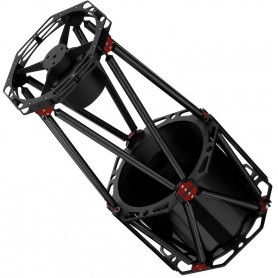
Omegon Ritchey-Chretien Pro RC 355/2845 Lightweight Truss OTA (68060)
7203.16 $
Tax included
The Omegon Pro RC 355/2845 is a professional-grade Ritchey-Chrétien reflector designed for advanced astrophotography and observatory use. It combines a large 355 mm aperture with a compact truss-tube structure and precision hyperbolic optics, delivering sharp, coma-free stars across a wide and fully illuminated field. This system features hyperbolic primary and secondary mirrors, eliminating the need for corrector lenses and significantly reducing optical aberrations. The result is a flat, well-corrected field ideal for large CCD cameras, with approximately 60 mm of illumination suitable for modern imaging sensors.
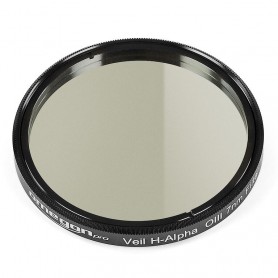
Omegon Filters Pro Veil H-Alpha OIII 7nm 2'' (82000)
229.5 $
Tax included
Artificial lighting from cities and towns brightens the night sky and reduces contrast, making faint celestial objects harder to observe. While streetlights improve visibility on the ground, they create skyglow that obscures delicate deep-sky structures. Emission nebulae differ from star clusters, galaxies and reflection nebulae because they radiate light at very specific wavelengths. Instead of producing a broad spectrum, they emit distinct spectral lines.
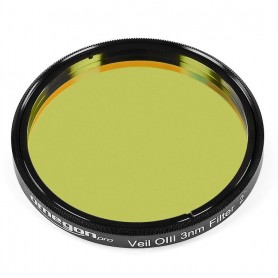
Omegon Filters Pro Veil OIII 3nm 2'' (82014)
315.84 $
Tax included
Artificial lighting in urban and suburban areas brightens the night sky and reduces contrast, making faint deep-sky objects more difficult to observe. Skyglow caused by streetlights and industrial lighting often overwhelms delicate nebular structures. Unlike galaxies, globular clusters or reflection nebulae, emission nebulae radiate light at specific wavelengths. Because the human eye has limited sensitivity in the red spectrum, only the O-III and H-Beta lines are easily visible visually. Cameras, however, can record all these wavelengths, including the deeper red emissions.
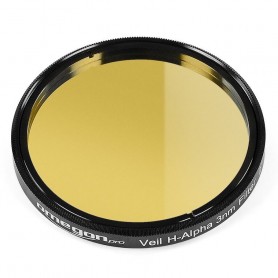
Omegon Filters Pro Veil H-Alpha 3nm 2'' (82012)
315.84 $
Tax included
Artificial lighting in urban and suburban areas brightens the night sky and reduces contrast, causing faint celestial objects to fade into the background. While streetlights improve visibility on the ground, they create skyglow that makes observing delicate nebular structures more challenging. Emission nebulae differ from galaxies, globular clusters and reflection nebulae because they emit light at specific wavelengths rather than across a broad spectrum.