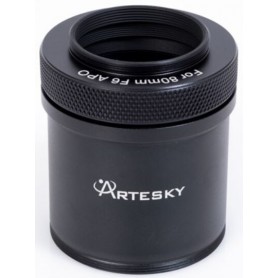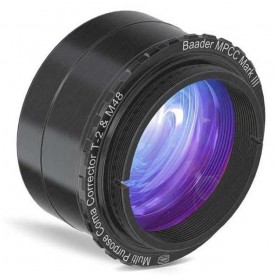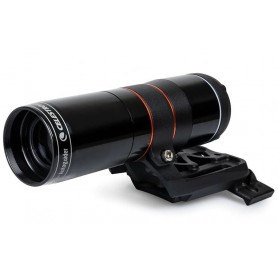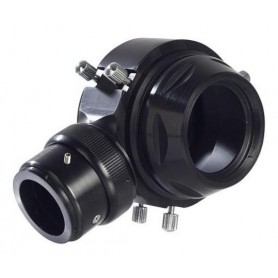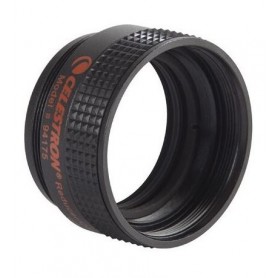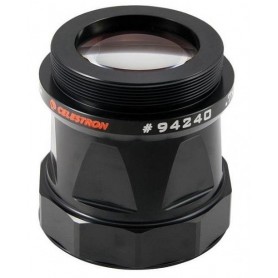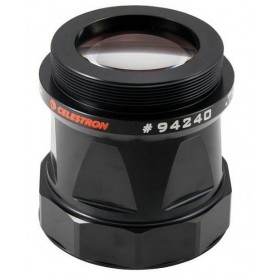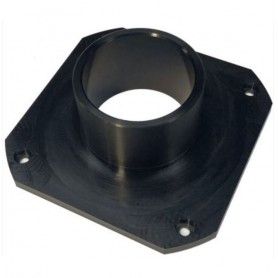
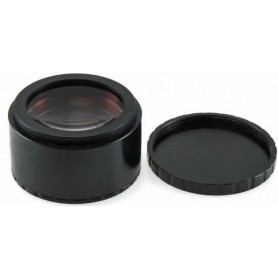
The flattener, also known as a field flattener, is a lens designed to rectify the slight curvature of the field caused by the primary optics. This curvature can result in less sharp stars at the edges of the field of view. By using a flattener, astrophotographers can ensure that stars remain crisp and well-defined across the entire exposure.
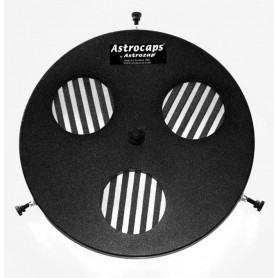
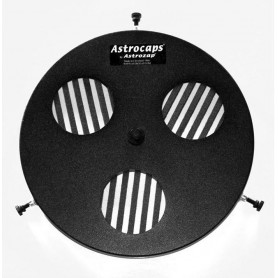
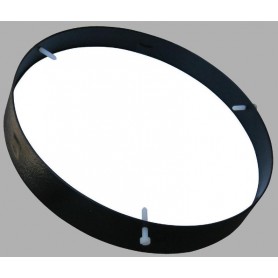
Astrozap focusing caps feature an integrated Bahtinov focusing wheel, offering versatility beyond standard masks. With a simple turn, the wheel opens for focusing and closes to safeguard against dust or for capturing dark frames with your CCD or DSLR camera, akin to a shutter-like operation.
Astrozap focusing caps come equipped with an integrated Bahtinov focusing wheel, offering a versatile solution compared to simple Hartman or Bahtinov masks. This multi-purpose tool allows for swift, 'shutter-like' operation: turn the wheel to the open position for focusing, then turn it again to the closed position to safeguard against dust or to capture dark frames with your CCD or DSLR camera.
Astrozap focusing caps feature an integrated Bahtinov focusing wheel, offering versatility beyond standard Hartman or Bahtinov masks. This multi-functional tool allows for swift, 'shutter-like' operation: simply turn the wheel to the open position for focusing, and then rotate it again to the closed position to prevent dust ingress or to capture dark frames with your CCD or DSLR camera.
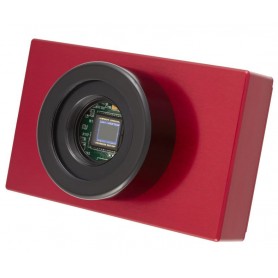
Introducing the Atik Infinity! From the outset, this camera was crafted with beginners in mind. Its sensitivity allows for displaying images of the brightest objects in just a few seconds. What sets it apart is the brand new software enabling real-time stacking. With very short exposures (like 5 seconds), the first image may appear noisy, but subsequent ones improve, with the software even adjusting for field rotation.
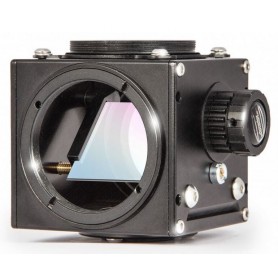
Telescope auxiliary instruments cover a wide range of interests, from eyepieces to high-end spectroscopy, yet most telescopes only feature one exit port. This leads to constant manual swapping of parts in the dark, resulting in time loss, wear on components, and frustration—especially evident when controlling the telescope remotely.
The Multipurpose Coma Corrector MARK III (MPCC III) stands out as the sole coma corrector for Newtonian telescopes that preserves the telescope's focal length and field of view.
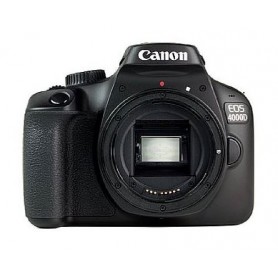
The lowercase "a" designates an astromodified version of this camera: Typically, these cameras are fitted with filters that dampen the red spectral range, aligning the sensor's color perception with that of human daytime vision. However, this poses a challenge in astronomy, as it includes the critical H-alpha line, crucial for capturing the glow of astronomical gas nebulae. Consequently, this filter is removed during astromodification.
This dual-purpose focal reducer and field corrector lens accessory is compatible with all Celestron Schmidt-Cassegrain telescopes ranging from 5" to 14" in aperture. Its innovative design allows for a dual focal ratio instrument without compromising image quality. Specifically, it operates at f/6.3 for C5, C8, C9¼, and C11 telescopes, and f/7 for the C14 telescope.
This reducer maintains optical integrity while also offering sufficient back focus for various photographic equipment, unlike typical universal reducers.